Don Riso Enneaagram Point 4

4
THE INDIVIDUALIST
Enneagram Type Four

The Sensitive, Introspective Type:
Expressive, Dramatic, Self-Absorbed, and Temperamental

Type Four in Brief

Fours are self-aware, sensitive, and reserved. They are emotionally honest, creative, and personal, but can also be moody and self-conscious. Withholding themselves from others due to feeling vulnerable and defective, they can also feel disdainful and exempt from ordinary ways of living. They typically have problems with melancholy, self-indulgence, and self-pity. At their Best: inspired and highly creative, they are able to renew themselves and transform their experiences.

  • Basic Fear: That they have no identity or personal significance
  • Basic Desire: To find themselves and their significance (to create an
    identity)
  • Enneagram Four with a Three-Wing: “The Aristocrat”
  • Enneagram Four with a Five-Wing: “The Bohemian”

Key Motivations: Want to express themselves and their individuality, to create and surround themselves with beauty, to maintain certain moods and feelings, to withdraw to protect their self-image, to take care of emotional needs before attending to anything else, to attract a “rescuer.”

The Meaning of the Arrows (in brief)

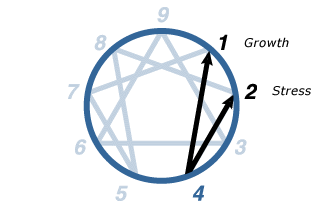
When moving in their Direction of Disintegration (stress), aloof Fours suddenly become over-involved and clinging at Two. However, when moving in their Direction of Integration (growth), envious, emotionally turbulent Fours become more objective and principled, like healthy OnesLearn more about the arrows.

Examples: Rumi, Frédéric Chopin, Pyotr I. Tchaikovsky, Gustav Mahler, Jackie Kennedy Onassis, Edgar Allen Poe, Yukio Mishima, Virginia Woolf, Anne Frank, Karen Blixen / Isak Dinesen, Anaîs Nin, Tennessee Williams, J.D. Salinger, Anne Rice, Frida Kahlo, Diane Arbus, Martha Graham, Rudolf Nureyev, Cindy Sherman, Hank Williams, Billie Holiday, Judy Garland, Maria Callas, Miles Davis, Keith Jarrett, Joni Mitchell, Bob Dylan, Paul Simon, Leonard Cohen, Yusuf Islam (Cat Stevens), Ferron, Cher, Stevie Nicks, Annie Lennox, Prince, Sarah McLachlan, Alanis Morrisette, Feist, Florence ( + the Machine) Welch, Amy Winehouse, Ingmar Bergman, Lars von Trier, Marlon Brando, Jeremy Irons, Angelina Jolie, Winona Ryder, Kate Winslet, Nicolas Cage, Johnny Depp, Tattoo Artist Kat Von D., Magician Criss Angel, Streetcar Named Desire’s “Blanche duBois”


Type Four Overview

We have named this type The Individualist because Fours maintain their identity by seeing themselves as fundamentally different from others. Fours feel that they are unlike other human beings, and consequently, that no one can understand them or love them adequately. They often see themselves as uniquely talented, possessing special, one-of-a-kind gifts, but also as uniquely disadvantaged or flawed. More than any other type, Fours are acutely aware of and focused on their personal differences and deficiencies.

Healthy Fours are honest with themselves: they own all of their feelings and can look at their motives, contradictions, and emotional conflicts without denying or whitewashing them. They may not necessarily like what they discover, but they do not try to rationalize their states, nor do they try to hide them from themselves or others. They are not afraid to see themselves “warts and all.” Healthy Fours are willing to reveal highly personal and potentially shameful things about themselves because they are determined to understand the truth of their experience—so that they can discover who they are and come to terms with their emotional history. This ability also enables Fours to endure suffering with a quiet strength. Their familiarity with their own darker nature makes it easier for them to process painful experiences that might overwhelm other types.

Nevertheless, Fours often report that they feel they are missing something in themselves, although they may have difficulty identifying exactly what that “something” is. Is it will power? Social ease? Self-confidence? Emotional tranquility?—all of which they see in others, seemingly in abundance. Given time and sufficient perspective, Fours generally recognize that they are unsure about aspects of their self-image—their personality or ego-structure itself. They feel that they lack a clear and stable identity, particularly a social persona that they feel comfortable with.

While it is true that Fours often feel different from others, they do not really want to be alone. They may feel socially awkward or self-conscious, but they deeply wish to connect with people who understand them and their feelings. The “romantics” of the Enneagram, they long for someone to come into their lives and appreciate the secret self that they have privately nurtured and hidden from the world. If, over time, such validation remains out of reach, Fours begin to build their identity around how unlike everyone else they are. The outsider therefore comforts herself by becoming an insistent individualist: everything must be done on her own, in her own way, on her own terms. Fours’ mantra becomes “I am myself. Nobody understands me. I am different and special,” while they secretly wish they could enjoy the easiness and confidence that others seem to enjoy.

Fours typically have problems with a negative self-image and chronically low self-esteem. They attempt to compensate for this by cultivating a Fantasy Self—an idealized self-image which is built up primarily in their imaginations. A Four we know shared with us that he spent most of his spare time listening to classical music while fantasizing about being a great concert pianist—à la Vladimir Horowitz. Unfortunately, his commitment to practicing fell far short of his fantasized self-image, and he was often embarrassed when people asked him to play for them. His actual abilities, while not poor, became sources of shame.

In the course of their lives, Fours may try several different identities on for size, basing them on styles, preferences, or qualities they find attractive in others. But underneath the surface, they still feel uncertain about who they really are. The problem is that they base their identity largely on their feelings. When Fours look inward they see a kaleidoscopic, ever-shifting pattern of emotional reactions. Indeed, Fours accurately perceive a truth about human nature—that it is dynamic and ever changing. But because they want to create a stable, reliable identity from their emotions, they attempt to cultivate only certain feelings while rejecting others. Some feelings are seen as “me,” while others are “not me.” By attempting to hold on to specific moods and express others, Fours believe that they are being true to themselves.

One of the biggest challenges Fours face is learning to let go of feelings from the past; they tend to nurse wounds and hold onto negative feelings about those who have hurt them. Indeed, Fours can become so attached to longing and disappointment that they are unable to recognize the many treasures in their lives.

Leigh is a working mother who has struggled with these difficult feelings for many years.

“I collapse when I am out in the world. I have had a trail of relationship disasters. I have hated my sister’s goodness—and hated goodness in general. I went years without joy in my life, just pretending to smile because real smiles would not come to me. I have had a constant longing for whatever I cannot have. My longings can never become fulfilled because I now realize that I am attached to ‘the longing’ and not to any specific end result.”

There is a Sufi story that relates to this about an old dog that had been badly abused and was near starvation. One day, the dog found a bone, carried it to a safe spot, and started gnawing away. The dog was so hungry that it chewed on the bone for a long time and got every last bit of nourishment that it could out of it. After some time, a kind old man noticed the dog and its pathetic scrap and began quietly setting food out for it. But the poor hound was so attached to its bone that it refused to let go of it and soon starved to death.

Fours are in the same predicament. As long as they believe that there is something fundamentally wrong with them, they cannot allow themselves to experience or enjoy their many good qualities. To acknowledge their good qualities would be to lose their sense of identity (as a suffering victim) and to be without a relatively consistent personal identity (their Basic Fear). Fours grow by learning to see that much of their story is not true—or at least it is not true any more. The old feelings begin to fall away once they stop telling themselves their old tale: it is irrelevant to who they are right now.

(from The Wisdom of the Enneagram, p. 180-182)


Listen: Don Riso Discusses Type Four

Individual Type Audio Recording for Type Four (excerpt)
Don Riso


Type Four—Levels of Development

Healthy Levels

Level 1 (At Their Best): Profoundly creative, expressing the personal and the universal, possibly in a work of art. Inspired, self-renewing and regenerating: able to transform all their experiences into something valuable: self-creative.

Level 2: Self-aware, introspective, on the “search for self,” aware of feelings and inner impulses. Sensitive and intuitive both to self and others: gentle, tactful, compassionate.

Level 3: Highly personal, individualistic, “true to self.” Self-revealing, emotionally honest, humane. Ironic view of self and life: can be serious and funny, vulnerable and emotionally strong.

Average Levels

Level 4: Take an artistic, romantic orientation to life, creating a beautiful, aesthetic environment to cultivate and prolong personal feelings. Heighten reality through fantasy, passionate feelings, and the imagination.

Level 5: To stay in touch with feelings, they interiorize everything, taking everything personally, but become self-absorbed and introverted, moody and hypersensitive, shy and self-conscious, unable to be spontaneous or to “get out of themselves.” Stay withdrawn to protect their self-image and to buy time to sort out feelings.

Level 6: Gradually think that they are different from others, and feel that they are exempt from living as everyone else does. They become melancholy dreamers, disdainful, decadent, and sensual, living in a fantasy world. Self-pity and envy of others leads to self-indulgence, and to becoming increasingly impractical, unproductive, effete, and precious.

Unhealthy Levels

Level 7: When dreams fail, become self-inhibiting and angry at self, depressed and alienated from self and others, blocked and emotionally paralyzed. Ashamed of self, fatigued and unable to function.

Level 8: Tormented by delusional self-contempt, self-reproaches, self-hatred, and morbid thoughts: everything is a source of torment. Blaming others, they drive away anyone who tries to help them.

Level 9: Despairing, feel hopeless and become self-destructive, possibly abusing alcohol or drugs to escape. In the extreme: emotional breakdown or suicide is likely. Generally corresponds to the Avoidant, Depressive, and Narcissistic personality disorders.


Compatibility with Other Types

Type 4 in relationship with type:

    2     3     4     5     6     7     8     9


Misidentification with Other Types

Type 4 compared with type:

1     2     3     5     6     7     8     9


Addictions

Over-indulgence in rich foods, sweets, alcohol to alter mood, to socialize, and for emotional consolation. Lack of physical activity. Bulimia. Depression. Tobacco, prescription drugs, or heroin for social anxiety. Cosmetic surgery to erase rejected features.


Personal Growth Recommendations
for Enneagram Type Fours

  • Do not pay so much attention to your feelings; they are not a true source of support for you, as you probably already know. Remember this advice: “From our present perspective, we can also see that one of the most important mistakes Fours make is to equate themselves with their feelings. The fallacy is that to understand themselves they must understand their feelings, particularly their negative ones, before acting. Fours do not see that the self is not the same as its feelings or that the presence of negative feelings does not preclude the presence of good in themselves” (Personality Types, p. 172). Always remember that your feelings are telling you something about yourself as you are at this particular moment, not necessarily more than that.
  • Avoid putting off things until you are “in the right mood.” Commit yourself to productive, meaningful work that will contribute to your good and that of others, no matter how small the contribution may be. Working consistently in the real world will create a context in which you can discover yourself and your talents. (Actually, you are happiest when you are working—that is, activating your potentials and realizing yourself. You will not “find yourself” in a vacuum or while waiting for inspiration to strike, so connect—and stay connected—with the real world.
  • Self-esteem and self-confidence will develop only from having positive experiences, whether or not you believe that you are ready to have them. Therefore, put yourself in the way of good. You may never feel that you are ready to take on a challenge of some sort, that you always need more time. (Fours typically never feel that they are sufficiently “together,” but they must nevertheless have the courage to stop putting off their lives.) Even if you start small, commit yourself to doing something that will bring out the best in you.
  • A wholesome self-discipline takes many forms, from sleeping regular hours to working regularly to exercising regularly, and has a cumulative, strengthening effect. Since it comes from yourself, a healthy self-discipline is not contrary to your freedom or individuality. On the other hand, sensuality, excessive sexual experiences, alcohol, drugs, sleep, or fantasizing have a debilitating effect on you, as you already know. Therefore, practice healthy self-discipline and stay with it.
  • Avoid lengthy conversations in your imagination, particularly if they are negative, resentful, or even excessively romantic. These conversations are essentially unreal and at best only rehearsals for action—although, as you know, you almost never say or do what you imagine you will. Instead of spending time imagining your life and relationships, begin to live them.
Don Riso Enneagram Point 3

3
THE ACHIEVER
Enneagram Type Three

The Success-Oriented, Pragmatic Type:
Adaptable, Excelling, Driven, and Image-Conscious


Type Three in Brief

Threes are self-assured, attractive, and charming. Ambitious, competent, and energetic, they can also be status-conscious and highly driven for advancement. They are diplomatic and poised, but can also be overly concerned with their image and what others think of them. They typically have problems with workaholism and competitiveness. At their Best: self-accepting, authentic, everything they seem to be—role models who inspire others.

  • Basic Fear: Of being worthless
  • Basic Desire: To feel valuable and worthwhile
  • Enneagram Three with a Two-Wing: “The Charmer”
  • Enneagram Three with a Four-Wing: “The Professional”

Key Motivations: Want to be affirmed, to distinguish themselves from others, to have attention, to be admired, and to impress others.

The Meaning of the Arrows (in brief)

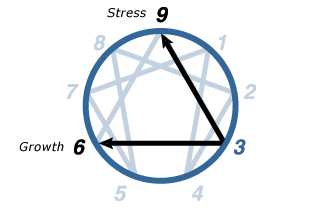
When moving in their Direction of Disintegration (stress), driven Threes suddenly become disengaged and apathetic at Nine. However, when moving in their Direction of Integration (growth), vain, deceitful Threes become more cooperative and committed to others, like healthy SixesLearn more about the arrows.

Examples: Augustus Caesar, Emperor Constantine, Bill Clinton, Tony Blair, Prince William, Condoleeza Rice, Arnold Schwarzenegger, Carl Lewis, Muhammed Ali, John Edwards, Mitt Romney, Bill Wilson (AA Founder), Andy Warhol, Truman Capote, Werner Erhard, Oprah Winfrey, Deepak Chopra, Tony Robbins, Bernie Madoff, Bryant Gumbel, Michael Jordan, O.J. Simpson, Tiger Woods, Lance Armstrong, Elvis Presley, Paul McCartney, Madonna, Sting, Whitney Houston, Jon Bon Jovi, Lady Gaga, Taylor Swift, Justin Bieber, Brooke Shields, Cindy Crawford, Tom Cruise, Barbra Streisand, Ben Kingsley, Jamie Foxx, Richard Gere, Ken Watanabe, Will Smith, Courteney Cox, Demi Moore, Kevin Spacey, Reese Witherspoon, Anne Hathaway, Chef Daniel Boulud, Dick Clark, Ryan Seacrest, Cat Deeley, Mad Men’s “Don Draper,” Glee’s “Rachel Berry”

Type Three Overview

We have named personality type Three The Achiever because when they are healthy, Threes really can and do achieve great things in the world. They are the “stars” of human nature, and people often look up to them because of their graciousness and personal accomplishments. Healthy Threes know how good it feels to develop themselves and contribute their abilities to the world, and also enjoy motivating others to greater personal achievements than others thought they were capable of. They are usually well regarded and popular among their peers, the type of person who is frequently voted “class president” or “home coming queen” because people feel they want to be associated with this kind of person who acts as a stand-in for them. Healthy Threes embody the best in a culture, and others are able to see their hopes and dreams mirrored in them.

Threes are often successful and well liked because, of all the types, they most believe in themselves and in developing their talents and capacities. Threes act as living “role models” and paragons because of their extraordinary embodiment of socially valued qualities. Healthy Threes know that they are worth the effort it takes to be “the best that they can be.” Their success at doing so inspires others to invest in their own self-development.

Threes want to make sure their lives are a success, however that is defined by their family, their culture, and their social sphere. In some families, success means having a lot of money, a grand house, a new, expensive car, and other status symbols. Others value ideas, and success to them means distinguishing oneself in academic or scientific worlds. Success in other circles might mean becoming famous as an actor, or model, or writer, or as a public figure of some kind, perhaps as a politician. A religious family might encourage a child to become a minister, priest, or rabbi since these professions have status in their community and in the eyes of the family. No matter how success is defined, Threes will try to become somebody noteworthy in their family and their community. They will not be a “nobody.”

To this end, Threes learn to perform in ways that will garner them praise and positive attention. As children, they learned to recognize the activities that were valued by their parents or peers, and put their energies into excelling in those activities. Threes also learned how to cultivate and develop whatever about them is attractive or potentially impressive.

Eve is a successful business-woman:

“My mother trained me to perform. I was about three when I performed my first solo in front of the church congregation. I got a lot of positive strokes for that and went on to perform in front of audiences throughout high school, either through music or debate. To this day, something mystical happens to me when I get in front of an audience. I ‘turn it on.’ I am called on frequently as a public speaker and some of my professional colleagues say that they hate following me on the program because I am such a hard act to follow!”

Everyone needs attention, encouragement, and the affirmation of their value in order to thrive, and Threes are the type which most exemplifies this universal human need. Threes want success not so much for the things that success will buy (like Sevens), or for the power and feeling of independence that it will bring (like Eights). They want success because they are afraid of disappearing into a chasm of emptiness and worthlessness: without the increased attention and feeling of accomplishment which success usually brings, Threes fear that they are nobody and have no value.

The problem is that, in the headlong rush to achieve whatever they believe will make them more valuable, Threes can become so alienated from themselves that they no longer know what they truly want, or what their real feelings or interests are. In this state, they are easy prey to self–deception, deceit, and falseness of all kinds. Thus, the deeper problem is that their search for a way to be of value increasingly takes them further away from their own Essential Self with its core of real value. From their earliest years, as Threes become dependent on receiving attention from others and in pursuing the values that others reward, they gradually lose touch with themselves. Step by step, their own inner core, their “heart’s desire,” is left behind until they no longer recognize it.

Thus, while they are the primary type in the Feeling Center, Threes, interestingly, are not known as “feeling” people; rather, they are people of action and achievement. It is as if they “put their feelings in a box” so that they can get ahead with what they want to achieve. Threes have come to believe that emotions get in the way of their performance, so they substitute thinking and practical action for feelings.

Jarvis is a well-educated and accomplished business professional; he sees that this pattern developed in him at an early age.

“I had no conscious awareness of this at the time, but when I was a child, I wasn’t allowed to have my feelings at all. They counted for nothing in the framework of my stepfather’s concept of what it took to be successful. I developed the habit of denying my feelings and instead focused on performing and getting good marks in school.”

Threes report that when they realize to what extent they have adapted their lives to the expectations of others, the question arises, “Well, then, what do I want?” They often simply did not know; it was not a question that had ever come up before. Thus, the fundamental dilemma of Threes is that they have not been allowed to be who they really are and to manifest their own authentic qualities. At a young age, they got the message that they were not allowed to have feelings and be themselves: they must, in effect, be someone else to be accepted. To some degree, all of the personality types have been sent the same message, but because of their particular background and makeup, Threes not only heard it, they began to live by it. The attention they received by performing in a certain way was their oxygen, and they needed it to breathe. Unfortunately, it came at a high price.

Marie, a skilled therapist describes the contradiction—and the pressure—of this orientation.

“For most of my life, people always noticed when I was involved in any kind of activity, and they have usually looked to me for some sort of direction. This has been a two-edged sword because while I wanted to be noticed and approved, the burden was that I had to be perfect—and that was tough.”

(from The Wisdom of the Enneagram, p. 153-155)


Type Three—Levels of Development

Healthy Levels

Level 1 (At Their Best): Self-accepting, inner-directed, and authentic, everything they seem to be. Modest and charitable, self-deprecatory humor and a fullness of heart emerge. Gentle and benevolent.

Level 2: Self-assured, energetic, and competent with high self-esteem: they believe in themselves and their own value. Adaptable, desirable, charming, and gracious.

Level 3: Ambitious to improve themselves, to be “the best they can be”—often become outstanding, a human ideal, embodying widely admired cultural qualities. Highly effective: others are motivated to be like them in some positive way.

Average Levels

Level 4: Highly concerned with their performance, doing their job well, constantly driving self to achieve goals as if self-worth depends on it. Terrified of failure. Compare self with others in search for status and success. Become careerists, social climbers, invested in exclusivity and being the “best.”

Level 5: Become image-conscious, highly concerned with how they are perceived. Begin to package themselves according to the expectations of others and what they need to do to be successful. Pragmatic and efficient, but also premeditated, losing touch with their own feelings beneath a smooth facade. Problems with intimacy, credibility, and “phoniness” emerge.

Level 6: Want to impress others with their superiority: constantly promoting themselves, making themselves sound better than they really are. Narcissistic, with grandiose, inflated notions about themselves and their talents. Exhibitionistic and seductive, as if saying “Look at me!” Arrogance and contempt for others is a defense against feeling jealous of others and their success.

Unhealthy Levels

Level 7: Fearing failure and humiliation, they can be exploitative and opportunistic, covetous of the success of others, and willing to do “whatever it takes” to preserve the illusion of their superiority.

Level 8: Devious and deceptive so that their mistakes and wrongdoings will not be exposed. Untrustworthy, maliciously betraying or sabotaging people to triumph over them. Delusionally jealous of others

Level 9: Become vindictive, attempting to ruin others’ happiness. Relentless, obsessive about destroying whatever reminds them of their own shortcomings and failures. Psychopathic behavior. Generally corresponds to the Narcissistic Personality Disorder.


Compatibility with Other Types

Type 3 in relationship with type:

1     2     3     4     5     6     7     8     9


Misidentification with Other Types

Type 3 compared with type:

1     2     4     5     6     7     8     9


Addictions

Over-stressing the body for recognition. Working out to exhaustion. Starvation diets. Workaholism. Excessive intake of coffee, stimulants, amphetamines, cocaine, steroids or excessive surgery for cosmetic improvement.


Personal Growth Recommendations
for Enneagram Type Threes

  • For our real development, it is essential to be truthful. Be honest with yourself and others about your genuine feelings and needs. Likewise, resist the temptation to impress others or inflate your importance. You will impress people more deeply by being authentic than by bragging about your successes or exaggerating your accomplishments.
  • Develop charity and cooperation in your relationships. You can do this by taking time to pause in a busy day to really connect with someone you care about. Nothing spectacular is required—simply a few moments of quiet appreciation. When you do so, you will become a more loving person, a more faithful friend—and a much more desirable individual. You will feel better about yourself.
  • Take breaks. You can drive yourself and others to exhaustion with your relentless pursuit of your goals. Ambition and self-development are good qualities, but temper them with rest periods in which you reconnect more deeply with yourself. Sometimes taking three to five deep breaths is enough to recharge your battery and improve your outlook.
  • Develop your social awareness. Many Threes have grown tremendously by getting involved in projects that had nothing to do with their own personal advancement. Working cooperatively with others toward goals that transcend personal interest is a powerful way of finding your true value and identity.
  • In their desire to be accepted by others, some average Threes adapt so much to the expectations of others that they lose touch with what they are really feeling about the situation. Develop yourself by resisting doing what is acceptable just to be accepted. It is imperative that you invest time in discovering your own core values.


Don Riso Enneagram Point 2

THE HELPER
Enneagram Type Two

The Caring, Interpersonal Type:
Generous, Demonstrative, People-Pleasing, and Possessive

Type Two in Brief

Twos are empathetic, sincere, and warm-hearted. They are friendly, generous, and self-sacrificing, but can also be sentimental, flattering, and people-pleasing. They are well-meaning and driven to be close to others, but can slip into doing things for others in order to be needed. They typically have problems with possessiveness and with acknowledging their own needs. At their Best: unselfish and altruistic, they have unconditional love for others.

  • Basic Fear: Of being unwanted, unworthy of being loved
  • Basic Desire: To feel loved
  • Enneagram Two with a One-Wing: “Servant”
  • Enneagram Two with a Three-Wing: “The Host/Hostess”

Key Motivations: Want to be loved, to express their feelings for others, to be needed and appreciated, to get others to respond to them, to vindicate their claims about themselves.

The Meaning of the Arrows (in brief)

When moving in their Direction of Disintegration (stress), needy Twos suddenly become aggressive and dominating at Eight. However, when moving in their Direction of Integration (growth), prideful, self-deceptive Twos become more self-nurturing and emotionally aware, like healthy FoursLearn more about the arrows.

Examples: Paramahansa Yogananda, Pope John XXIII, Guru Ammaji (“The Hugging Saint”), Byron Katie, Bishop Desmond Tutu, Eleanor Roosevelt, Nancy Reagan, Monica Lewinsky, Ann Landers, Mary Kay Ash (Mary Kay Cosmetics), Leo Buscaglia, Richard Simmons, Luciano Pavarotti, John Denver, Lionel Richie, Stevie Wonder, Barry Manilow, Dolly Parton, Josh Groban, Music of Journey, Bobby McFerrin, Kenny G, Paula Abdul, Priscilla Presley, Elizabeth Taylor, Danny Thomas, Martin Sheen, Jennifer Tilly, Danny Glover, Richard Thomas “John Boy Walton,” Juliette Binoche, Arsenio Hall, Timothy Treadwell “Grizzly Man,” “Melanie Hamilton Wilkes” (Gone with the Wind), “Eve Harrington” (All About Eve), “Dr. McCoy” (Star Trek)

Type Two Overview

We have named personality type Two The Helper because people of this type are either the most genuinely helpful to other people or, when they are less healthy they are the most highly invested in seeing themselves as helpful. Being generous and going out of their way for others makes Twos feel that theirs is the richest, most meaningful way to live. The love and concern they feel—and the genuine good they do—warms their hearts and makes them feel worthwhile. Twos are most interested in what they feel to be the “really, really good” things in life—love, closeness, sharing, family, and friendship.

Louise is a minister who shares the joy she finds in being a Two.

“I cannot imagine being another type and I would not want to be another type. I like being involved in peoples’ lives. I like feeling compassionate, caring, nurturing. I like cooking and homemaking. I like having the confidence that anyone can tell me anything about themselves and I will be able to love them….I am really proud of myself and love myself for being able to be with people where they are. I really can, and do, love people, pets, and things. And I am a great cook!”

When Twos are healthy and in balance, they really are loving, helpful, generous, and considerate. People are drawn to them like bees to honey. Healthy Twos warm others in the glow of their hearts. They enliven others with their appreciation and attention, helping people to see positive qualities in themselves that they had not previously recognized. In short, healthy Twos are the embodiment of “the good parent” that everyone wishes they had: someone who sees them as they are, understands them with immense compassion, helps and encourages with infinite patience, and is always willing to lend a hand—while knowing precisely how and when to let go. Healthy Twos open our hearts because theirs are already so open and they show us the way to be more deeply and richly human.

Louise continues:

“All of my jobs revolved around helping people. I was a teacher who wanted to be sensitive to children and help them get off to a good start. I was a religious education director in a number of parishes. I thought that if people learned about the spiritual life, they’d be happier…The most important part of my life is my spiritual life. I was in a religious community for ten years. I married a former priest, and we both have our spirituality as the basis of our life together.”

However, Twos’ inner development may be limited by their “shadow side”—pride, self-deception, the tendency to become over-involved in the lives of others, and the tendency to manipulate others to get their own emotional needs met. Transformational work entails going into dark places in ourselves, and this very much goes against the grain of the Two’s personality structure, which prefers to see itself in only the most positive, glowing terms.

Perhaps the biggest obstacle facing Twos, Threes, and Fours in their inner work is having to face their underlying Center fear of worthlessness. Beneath the surface, all three types fear that they are without value in themselves, and so they must be or do something extraordinary in order to win love and acceptance from others. In the average to unhealthy Levels, Twos present a false image of being completely generous and unselfish and of not wanting any kind of pay-off for themselves, when in fact, they can have enormous expectations and unacknowledged emotional needs.

Average to unhealthy Twos seek validation of their worth by obeying their superego’s demands to sacrifice themselves for others. They believe they must always put others first and be loving and unselfish if they want to get love. The problem is that “putting others first” makes Twos secretly angry and resentful, feelings they work hard to repress or deny. Nevertheless, they eventually erupt in various ways, disrupting Twos’ relationships and revealing the inauthenticity of many of the average to unhealthy Two’s claims about themselves and the depth of their “love.”

But in the healthy range, the picture is completely different. My own (Don’s) maternal grandmother was an archetypal Two. During World War II, she was “Moms” to what seemed like half of Keesler Air Force Base in Biloxi, Mississippi, feeding the boys, allowing her home to be used as a “home away from home,” giving advice and consolation to anyone lonely or fearful about going to war. Although she and her husband were not wealthy and had two teenage children of their own, she cooked extra meals for the servicemen, put them up at night, and saw to it that their uniforms had all of their buttons and were well pressed. She lived until her 80’s, remembering those years as the happiest and most fulfilling of her life—probably because her healthy Two capacities were so fully and richly engaged.

(from The Wisdom of the Enneagram, p. 127-128)

Type Two—Levels of Development

Healthy Levels

Level 1 (At Their Best): Become deeply unselfish, humble, and altruistic: giving unconditional love to self and others. Feel it is a privilege to be in the lives of others.

Level 2: Empathetic, compassionate, feeling for others. Caring and concerned about their needs. Thoughtful, warm-hearted, forgiving and sincere.

Level 3: Encouraging and appreciative, able to see the good in others. Service is important, but takes care of self too: they are nurturing, generous, and giving—a truly loving person.

Average Levels

Level 4: Want to be closer to others, so start “people pleasing,” becoming overly friendly, emotionally demonstrative, and full of “good intentions” about everything. Give seductive attention: approval, “strokes,” flattery. Love is their supreme value, and they talk about it constantly.

Level 5: Become overly intimate and intrusive: they need to be needed, so they hover, meddle, and control in the name of love. Want others to depend on them: give, but expect a return: send double messages. Enveloping and possessive: the codependent, self-sacrificial person who cannot do enough for others—wearing themselves out for everyone, creating needs for themselves to fulfill.

Level 6: Increasingly self-important and self-satisfied, feel they are indispensable, although they overrate their efforts in others’ behalf. Hypochondria, becoming a “martyr” for others. Overbearing, patronizing, presumptuous.

Unhealthy Levels

Level 7: Can be manipulative and self-serving, instilling guilt by telling others how much they owe them and make them suffer. Abuse food and medication to “stuff feelings” and get sympathy. Undermine people, making belittling, disparaging remarks. Extremely self-deceptive about their motives and how aggressive and/or selfish their behavior is.

Level 8: Domineering and coercive: feel entitled to get anything they want from others: the repayment of old debts, money, sexual favors.

Level 9: Able to excuse and rationalize what they do since they feel abused and victimized by others and are bitterly resentful and angry. Somatization of their aggressions results in chronic health problems as they vindicate themselves by “falling apart” and burdening others. Generally corresponds to the Histrionic Personality Disorder and Factitious Disorder.

Compatibility with Other Types

Type 2 in relationship with type:

1    2     3     4      5      6      7     8     9

Misidentification with Other Types

Type 2 compared with type:

1    3     4      5      6      7     8     9

Addictions

Abusing food and over-the-counter medications. Bingeing, especially on sweets and carbohydrates. Over-eating from feeling “love-starved;” in extreme cases bulimia. Hypochondria to look for sympathy.

Personal Growth Recommendations
for Enneagram Type Twos

  • First and foremost, remember that if you are not addressing your own needs, it is highly unlikely that you will be able to meet anyone else’s needs without problems, underlying resentments, and continual frustration. Further, you will be less able to respond to people in a balanced way if you have not gotten adequate rest, and taken care of yourself properly. It is not selfish to make sure that you are okay before attending to others’ needs—it is simply common sense.
  • Try to become more conscious of your own motives when you decide to help someone. While doing good things for people is certainly an admirable trait, when you do so because you expect the other person to appreciate you or do something nice for you in return, you are setting yourself up for disappointments. Your type has a real danger of falling into unconscious codependent patterns with loved ones, and they almost never bring you what you really want.
  • While there are many things you might want to do for people, it is often better to ask them what they really need first. You are gifted at accurately intuiting others’ feelings and needs, but that does not necessarily mean that they want those needs remedied by you in the way you have in mind. Communicate your intentions, and be willing to accept a “no thank you.” Someone deciding that they do not want your particular offer of help does not mean that they dislike you or are rejecting you.
  • Resist the temptation to call attention to yourself and your good works. After you have done something for others, do not remind them about it. Let it be: either they will remember your kindness themselves and thank you in their own way or they will not. Your calling attention to what you have done for them only puts people on the spot and makes them feel uneasy. It will not satisfy anyone or improve your relationships.
  • Learn to recognize the affection and good wishes of others, even when these are not in terms that you are familiar with. Although others may not express their feelings in a way that you want, they may be letting you know in other ways how much they care about you. If you can recognize what others are giving you, you will rest more easily in the knowledge that you really are loved. Love is always available but only to the degree that we are present and therefore receptive to it.


Posted in Two

Don Riso on Enneagram 1

1 – THE REFORMER
Enneagram Type One

The Rational, Idealistic Type:
Principled, Purposeful, Self-Controlled, and Perfectionistic

Type One in Brief

Ones are conscientious and ethical, with a strong sense of right and wrong. They are teachers, crusaders, and advocates for change: always striving to improve things, but afraid of making a mistake. Well-organized, orderly, and fastidious, they try to maintain high standards but can slip into being critical and perfectionistic. They typically have problems with resentment and impatience. At their Best: wise, discerning, realistic, and noble. Can be morally heroic.

  • Basic Fear: Of being corrupt/evil, defective
  • Basic Desire: To be good, to have integrity, to be balanced
  • Enneagram One with a Nine-Wing: “The Idealist”
  • Enneagram One with a Two-Wing: “The Advocate”

Key Motivations: Want to be right, to strive higher and improve everything, to be consistent with their ideals, to justify themselves, to be beyond criticism so as not to be condemned by anyone.

The Meaning of the Arrows (in brief)

When moving in their Direction of Disintegration (stress), methodical Ones suddenly become moody and irrational at Four. However, when moving in their Direction of Integration (growth), angry, critical Ones become more spontaneous and joyful, like healthy SevensLearn more about the arrows.

Examples: Confucius, Plato, Salahuddin Ayyubi, Joan of Arc, Sir Thomas More, Mahatma Gandhi, Pope John Paul II, Nelson Mandela, Margaret Thatcher, Prince Charles, Kate Middleton, Duchess of Cambridge, Jimmy Carter, Michelle Obama, Al Gore, Hillary Clinton, Rudy Giuliani, Elliot Spitzer, Justice Sandra Day O’Connor, Osama bin Laden, George Bernard Shaw, Thoreau, Dr. Jack Kevorkian, Anita Roddick (The Body Shop), Martha Stewart, Chef Thomas Keller, Michio Kushi (macrobiotics), George Harrison, Joan Baez, Celine Dion, Ralph Nader, Noam Chomsky, Bill Moyers, George F. Will, William F. Buckley, Keith Olbermann, Jerry Seinfeld, Bill Maher, Tina Fey, Katherine Hepburn, Maggie Smith, Emma Thompson, Julie Andrews, Vanessa Redgrave, Jane Fonda, Meryl Streep, Harrison Ford, Helen Hunt, Captain “Sully” Sullenberger, “Mary Poppins,” “Mr. Spock,” SNL’s “The Church Lady”

Type One Overview

We have named personality type One The Reformer because Ones have a “sense of mission” that leads them to want to improve the world in various ways, using whatever degree of influence they have. They strive to overcome adversity—particularly moral adversity—so that the human spirit can shine through and make a difference. They strive after “higher values,” even at the cost of great personal sacrifice.

History is full of Ones who have left comfortable lives to do something extraordinary because they felt that something higher was calling them. During the Second World War, Raoul Wallenburg left a comfortable middle-class life to work for the protection of thousands of European Jews from invading Nazis. In India, Gandhi left behind his wife and family and life as a successful lawyer to become an itinerant advocate of Indian independence and non-violent social changes. Joan of Arc left her village in France to restore the throne to the Dauphin and to expel the English from the country. The idealism of each of these Ones has inspired millions.

Ones are people of practical action—they wish to be useful in the best sense of the word. On some level of consciousness, they feel that they “have a mission” to fulfill in life, if only to try their best to reduce the disorder they see in their environment.

Although Ones have a strong sense of purpose, they also typically feel that they have to justify their actions to themselves, and often to others as well. This orientation causes Ones to spend a lot of time thinking about the consequences of their actions, as well as about how to keep from acting contrary to their convictions. Because of this, Ones often persuade themselves that they are “head” types, rationalists who proceed only on logic and objective truth. But, the real picture is somewhat different: Ones are actually activists who are searching for an acceptable rationale for what they feel they must do. They are people of instinct and passion who use convictions and judgments to control and direct themselves and their actions.

In the effort to stay true to their principles, Ones resist being affected by their instinctual drives, consciously not giving in to them or expressing them too freely. The result is a personality type that has problems with repression, resistance, and aggression. They are usually seen by others as highly self- controlled, even rigid, although this is not how Ones experience themselves. It seems to them that they are sitting on a cauldron of passions and desires, and they had better “keep the lid on” lest they and everyone else around them regret it.

Cassandra is a therapist in private practice who recalls the difficulty this caused her in her youth.

“I remember in high school getting feedback that I had no feelings. Inside, I felt my feelings intensely and yet I just couldn’t let them out as intensely as I felt them. Even now, if I have a conflict with a friend and need to address an issue, I rehearse ahead of time how to express clearly what I want, need, and observe, and yet not be harsh or blaming in my anger which is often scathing.”

Ones believe that being strict with themselves (and eventually becoming “perfect”) will justify them in their own eyes and in the eyes of others. But by attempting to create their own brand of perfection, they often create their own personal hell. Instead of agreeing with the statement in Genesis that God saw what He had created, “and it was good,” Ones intensely feel that “It wasn’t—there obviously have been some mistakes here!” This orientation makes it difficult for them to trust their inner guidance—indeed, to trust life—so Ones come to rely heavily on their superego, a learned voice from their childhood, to guide them toward “the greater good” which they so passionately seek. When Ones have gotten completely entranced in their personality, there is little distinction between them and this severe, unforgiving voice. Separating from it and seeing its genuine strengths and limitations is what growth for Ones is about.

(from The Wisdom of the Enneagram, p. 99-100)

Type One—Levels of Development

Healthy Levels

Level 1 (At Their Best): Become extraordinarily wise and discerning. By accepting what is, they become transcendentally realistic, knowing the best action to take in each moment. Humane, inspiring, and hopeful: the truth will be heard.

Level 2: Conscientious with strong personal convictions: they have an intense sense of right and wrong, personal religious and moral values. Wish to be rational, reasonable, self-disciplined, mature, moderate in all things.

Level 3: Extremely principled, always want to be fair, objective, and ethical: truth and justice primary values. Sense of responsibility, personal integrity, and of having a higher purpose often make them teachers and witnesses to the truth.

Average Levels

Level 4: Dissatisfied with reality, they become high-minded idealists, feeling that it is up to them to improve everything: crusaders, advocates, critics. Into “causes” and explaining to others how things “ought” to be.

Level 5: Afraid of making a mistake: everything must be consistent with their ideals. Become orderly and well-organized, but impersonal, puritanical, emotionally constricted, rigidly keeping their feelings and impulses in check. Often workaholics—”anal-compulsive,” punctual, pedantic, and fastidious.

Level 6: Highly critical both of self and others: picky, judgmental, perfectionistic. Very opinionated about everything: correcting people and badgering them to “do the right thing”—as they see it. Impatient, never satisfied with anything unless it is done according to their prescriptions. Moralizing, scolding, abrasive, and indignantly angry.

Unhealthy Levels

Level 7: Can be highly dogmatic, self-righteous, intolerant, and inflexible. Begin dealing in absolutes: they alone know “The Truth.” Everyone else is wrong: very severe in judgments, while rationalizing own actions.

Level 8: Become obsessive about imperfection and the wrongdoing of others, although they may fall into contradictory actions, hypocritically doing the opposite of what they preach.

Level 9: Become condemnatory toward others, punitive and cruel to rid themselves of wrongdoers. Severe depressions, nervous breakdowns, and suicide attempts are likely. Generally corresponds to the Obsessive-Compulsive and Depressive personality disorders.

Compatibility with Other Types

Type 1 in relationship with type:

1     2     3     4     5     6     7     8     9

Misidentification with Other Types

Type 1 compared with type:

2     3     4     5     6     7     8     9

Addictions

Excessive use of diets, vitamins, and cleansing techniques (fasts, diet pills, enemas). Under-eating for self-control: in extreme cases anorexia and bulimia. Alcohol to relieve tension.

Personal Growth Recommendations
for Enneagram Type Ones

  • Learn to relax. Take some time for yourself, without feeling that everything is up to you or that what you do not accomplish will result in chaos and disaster. Mercifully, the salvation of the world does not depend on you alone, even though you may sometimes feel it does.
  • You have a lot to teach others and are probably a good teacher, but do not expect others to change immediately. What is obvious to you may not be as obvious to them, especially if they are not used to being as self-disciplined and objective about themselves as you are about yourself. Many people may also want to do what is right and may agree with you in principle but for various reasons simply cannot change right away. The fact that others do not change immediately according to your prescriptions does not mean that they will not change sometime in the future. Your words and above all, your example may do more good than you realize, although they may take longer than you expect. So have patience.
  • It is easy for you to work yourself up into a lather about the wrongdoings of others. And it may sometimes be true that they are wrong. But what is it to you? Your irritation with them will do nothing to help them see another way of being. Similarly, beware of your constant irritation with your own “shortcomings.” Does your own harsh self-criticism really help you to improve? Or does it simply make you tense, nervous, and self-doubting? Learn to recognize the attacks of your superego and how they undermine rather than help you.
  • It is important for you to get in touch with your feelings, particularly your unconscious impulses. You may find that you are uneasy with your emotions and your sexual and aggressive impulses—in short, with the messy human things that make us human. It might be beneficial to keep a journal or to get into some kind of group therapy or other group work both to develop your emotions and to see that others will not condemn you for having human needs and limitations.
  • Your Achilles’ heel is your self-righteous anger. You get angry easily and are offended by what seems to you to be the perverse refusal of others to do the right thing—as you have defined it. Try to step back and see that your anger alienates people so that they cannot hear many of the good things you have to say. Further, your own repressed anger may well be giving you an ulcer or high blood pressure and is a harbinger of worse things to come.

Learn More

The Riso-Hudson Books offer the most complete type descriptions available anywhere. Personality Types is the most complete, in-depth, systematic treatment of the nine types and the Enneagram system as a whole, and The Wisdom of the Enneagram provides the comprehensive guide to psychological and spiritual growth for the nine personality types.


https://enneagram.tonilamotta.com/teaching-notes/checklists/


Don Riso on Enneagram Type 9

THE PEACEMAKER
Enneagram Type Nine

The Easygoing, Self-Effacing Type:
Receptive, Reassuring Agreeable, and Complacent

Type Nine in Brief

Nines are accepting, trusting, and stable. They are usually creative, optimistic, and supportive, but can also be too willing to go along with others to keep the peace. They want everything to go smoothly and be without conflict, but they can also tend to be complacent, simplifying problems and minimizing anything upsetting. They typically have problems with inertia and stubbornness. At their Best: indomitable and all-embracing, they are able to bring people together and heal conflicts.

  • Basic Fear: Of loss and separation
  • Basic Desire: To have inner stability “peace of mind”
  • Enneagram Nine with an Eight-Wing: “The Referee”
  • Enneagram Nine with a One-Wing: “The Dreamer”

Key Motivations: Want to create harmony in their environment, to avoid conflicts and tension, to preserve things as they are, to resist whatever would upset or disturb them.

The Meaning of the Arrows (in brief)

When moving in their Direction of Disintegration (stress), complacent Nines suddenly become anxious and worried at Six. However, when moving in their Direction of Integration (growth), slothful, self-neglecting Nines become more self-developing and energetic, like healthy ThreesLearn more about the arrows.

Examples: Queen Elizabeth II, Princess Grace of Monaco, Claude Monet, Norman Rockwell, Abraham Lincoln, Dwight D. Eisenhower, Gerald Ford, Ronald Reagan, George W. Bush, John F. Kennedy, Jr., General Colin Powell, Walter Cronkite, Carl Jung, Carl Rogers, Joseph Campbell, Walt Disney, Jim Henson (Muppets), Garrison Keillor, Gloria Steinem, Tony Bennett, Ringo Starr, Carlos Santana, James Taylor, Janet Jackson, Jack Johnson, George Lucas, Ron Howard, Gary Cooper, Jimmy Stewart, Audrey Hepburn, Sophia Loren, Kevin Costner, Annette Bening, Jeff Bridges, Morgan Freeman, John Goodman, Matthew Broderick, Whoopie Goldberg, Woody Harrelson, Geena Davis, Jason Segel, Lisa Kudrow, Tobey McGuire, Zooey Deschanel, “Mister Rogers,” “Homer and Marge Simpson”

Type Nine Overview

We have called personality type Nine The Peacemaker because no type is more devoted to the quest for internal and external peace for themselves and others. They are typically “spiritual seekers” who have a great yearning for connection with the cosmos, as well as with other people. They work to maintain their peace of mind just as they work to establish peace and harmony in their world. The issues encountered in the Nine are fundamental to all psychological and spiritual work—being awake versus falling asleep to our true nature; presence versus entrancement, openness versus blockage, tension versus relaxation, peace versus pain, union versus separation.

Ironically, for a type so oriented to the spiritual world, Nine is the center of the Instinctive Center, and is the type that is potentially most grounded in the physical world and in their own bodies. The contradiction is resolved when we realize that Nines are either in touch with their instinctive qualities and have tremendous elemental power and personal magnetism, or they are cut off from their instinctual strengths and can be disengaged and remote, even lightweight.

To compensate for being out of touch with their instinctual energies, Nines also retreat into their minds and their emotional fantasies. (This is why Nines can sometimes misidentify themselves as Fives and Sevens, “head types,” or as Twos and Fours, “feeling types.”) Furthermore, when their instinctive energies are out of balance, Nines use these very energies against themselves, damming up their own power so that everything in their psyches becomes static and inert. When their energy is not used, it stagnates like a spring-fed lake that becomes so full that its own weight dams up the springs that feed it. When Nines are in balance with their Instinctive Center and its energy, however, they are like a great river, carrying everything along with it effortlessly.

We have sometimes called the Nine the crown of the Enneagram because it is at the top of the symbol and because it seems to include the whole of it. Nines can have the strength of Eights, the sense of fun and adventure of Sevens, the dutifulness of Sixes, the intellectualism of Fives, the creativity of Fours, the attractiveness of Threes, the generosity of Twos, and the idealism of Ones. However, what they generally do not have is a sense of really inhabiting themselves—a strong sense of their own identity.

Ironically, therefore, the only type the Nine is not like is the Nine itself. Being a separate self, an individual who must assert herself against others, is terrifying to Nines. They would rather melt into someone else or quietly follow their idyllic daydreams.

Red, a nationally known business consultant, comments on this tendency:

“I am aware of focusing on other people, wondering what they are like, how and where they live, etc. In a relationship with others, I often give up my own agenda in favor of the other person’s. I have to be on guard about giving in to other’s demands and discounting my own legitimate needs.”

Nines demonstrate the universal temptation to ignore the disturbing aspects of life and to seek some degree of peace and comfort by “numbing out.” They respond to pain and suffering by attempting to live in a state of premature peacefulness, whether it is in a state of false spiritual attainment, or in more gross denial. More than any other type, Nines demonstrate the tendency to run away from the paradoxes and tensions of life by attempting to transcend them or by seeking to find simple and painless solutions to their problems.

To emphasize the pleasant in life is not a bad thing, of course—it is simply a limited and limiting approach to life. If Nines see the silver lining in every cloud as a way of protecting themselves from the cold and rain, other types have their distorting viewpoints, too. For example, Fours focus on their own woundedness and victimization, Ones on what is wrong with how things are, and so forth. By contrast, Nines tend to focus on the “bright side of life” so that their peace of mind will not be shaken. But rather than deny the dark side of life, what Nines must understand is that all of the perspectives presented by the other types are true, too. Nines must resist the urge to escape into “premature Buddhahood” or the “white light” of the Divine and away from the mundane world. They must remember that “the only way out is through.”

(from The Wisdom of the Enneagram, p. 316-317)

Type Nine—Levels of Development

Healthy Levels

Level 1 (At Their Best): Become self-possessed, feeling autonomous and fulfilled: have great equanimity and contentment because they are present to themselves. Paradoxically, at one with self, and thus able to form more profound relationships. Intensely alive, fully connected to self and others.

Level 2: Deeply receptive, accepting, unselfconscious, emotionally stable and serene. Trusting of self and others, at ease with self and life, innocent and simple. Patient, unpretentious, good-natured, genuinely nice people.

Level 3: Optimistic, reassuring, supportive: have a healing and calming influence—harmonizing groups, bringing people together: a good mediator, synthesizer, and communicator.

Average Levels

Level 4: Fear conflicts, so become self-effacing and accommodating, idealizing others and “going along” with their wishes, saying “yes” to things they do not really want to do. Fall into conventional roles and expectations. Use philosophies and stock sayings to deflect others.

Level 5: Active, but disengaged, unreflective, and inattentive. Do not want to be affected, so become unresponsive and complacent, walking away from problems, and “sweeping them under the rug.” Thinking becomes hazy and ruminative, mostly comforting fantasies, as they begin to “tune out” reality, becoming oblivious. Emotionally indolent, unwillingness to exert self or to focus on problems: indifference.

Level 6: Begin to minimize problems, to appease others and to have “peace at any price.” Stubborn, fatalistic, and resigned, as if nothing could be done to change anything. Into wishful thinking, and magical solutions. Others frustrated and angry by their procrastination and unresponsiveness.

Unhealthy Levels

Level 7: Can be highly repressed, undeveloped, and ineffectual. Feel incapable of facing problems: become obstinate, dissociating self from all conflicts. Neglectful and dangerous to others.

Level 8: Wanting to block out of awareness anything that could affect them, they dissociate so much that they eventually cannot function: numb, depersonalized.

Level 9: They finally become severely disoriented and catatonic, abandoning themselves, turning into shattered shells. Multiple personalities possible. Generally corresponds to the Schizoid and Dependent personality disorders.

Compatibility with Other Types

Type 9 in relationship with type:

1     2     3     4     5     6     7     8     9

Misidentification with Other Types

Type 9 compared with type:

1     2     3     4     5     6     7     8

Addictions

Over-eating or under-eating due to lack of self-awareness and repressed anger. Lack of physical activity. Depressants and psychotropics, alcohol, marijuana, narcotics to deaden loneliness and anxiety.

Personal Growth Recommendations
for Enneagram Type Nines

  • It is worth examining your type’s tendency to go along with others, doing what they want to keep the peace and be nice. Will constantly acquiescing to the wishes of others provide the kind of relationships that will really satisfy you? Remember, it is impossible to love others if you are not truly present to them. This means that you have to be yourself, that you (paradoxically) have to be independent so that you can really be there for others when they need you.
  • Exert yourself. Force yourself to pay attention to what is going on. Do not drift off or tune out people, or daydream. Work on focusing your attention to become an active participant in the world around you. Try to become more mentally and emotionally engaged.
  • Recognize that you also have aggressions, anxieties, and other feelings that you must deal with. Negative feelings and impulses are a part of you and they affect you emotionally and physically whether or not you acknowledge them. Furthermore, your negative emotions are often expressed inadvertently and get in the way of the peace and harmony you want in your relationships. It is best to get things out in the open first, at least by allowing yourself to become aware of your feelings.
  • Although this will be very painful for you, if your marriage has ended in divorce or if you are having problems with your children, you must honestly examine how you have contributed to these problems. Examining troubled relationships will be extremely difficult because the people involved have been close to your heart. The feelings you have for others endow you with much of your identity and self-esteem. But if you really love others, you can do no less than examine the role you have played in whatever conflicts that have arisen. In the last analysis, the choice is simple: you must sacrifice your peace of mind (in the short run) for the satisfaction of genuine relationships (in the long run.)

Don Riso on Enneagram 8


8
THE CHALLENGER
Enneagram Type Eight

The Powerful, Dominating Type:
Self-Confident, Decisive, Willful, and Confrontational


Type Eight in Brief

Eights are self-confident, strong, and assertive. Protective, resourceful, straight-talking, and decisive, but can also be ego-centric and domineering. Eights feel they must control their environment, especially people, sometimes becoming confrontational and intimidating. Eights typically have problems with their tempers and with allowing themselves to be vulnerable. At their Best: self- mastering, they use their strength to improve others’ lives, becoming heroic, magnanimous, and inspiring.

  • Basic Fear: Of being harmed or controlled by others
  • Basic Desire: To protect themselves (to be in control of their own life
    and destiny)
  • Enneagram Eight with a Seven-Wing: “The Maverick”
  • Enneagram Eight with a Nine-Wing: “The Bear”

Key Motivations: Want to be self-reliant, to prove their strength and resist weakness, to be important in their world, to dominate the environment, and to stay in control of their situation.

The Meaning of the Arrows (in brief)

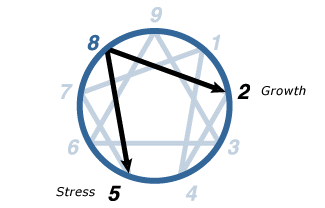
When moving in their Direction of Disintegration (stress), self-confident Eights suddenly become secretive and fearful at Five. However, when moving in their Direction of Integration (growth), lustful, controlling Eights become more open-hearted and caring, like healthy TwosLearn more about the arrows.

Examples: G.I. Gurdjieff, Richard Wagner, Franklin D. Roosevelt, Winston Churchill, Oskar Schindler, Fidel Castro, Martin Luther King, Jr., Lyndon Johnson, Mikhail Gorbachev, Golda Meir, Indira Gandhi, Saddam Hussein, Senator John McCain, Donald Trump, Pablo Picasso, Ernest Hemingway, Norman Mailer, Toni Morrison, Serena Williams, James Brown, Aretha Franklin, Keith Richards, Queen Latifah, Courtney Love, Jack Black, Chrissie Hynde, Pink, John Wayne, Frank Sinatra, Humphrey Bogart, Lauren Bacall, Bette Davis, Mae West, Sean Connery, Paul Newman, Clint Eastwood, Tommy Lee Jones, Jack Nicholson, Susan Sarandon, Russell Crowe, Sean Penn, Harvey Keitel, Matt Damon, Alec Baldwin, Roseanne Barr, Barbara Walters, Rosie O’Donnell, “Dr. Phil” McGraw, “Tony Soprano”


Type Eight Overview

We have named personality type Eight The Challenger because, of all the types, Eights enjoy taking on challenges themselves as well as giving others opportunities that challenge them to exceed themselves in some way. Eights are charismatic and have the physical and psychological capacities to persuade others to follow them into all kinds of endeavors—from starting a company, to rebuilding a city, to running a household, to waging war, to making peace.

Eights have enormous willpower and vitality, and they feel most alive when they are exercising these capacities in the world. They use their abundant energy to effect changes in their environment—to “leave their mark” on it—but also to keep the environment, and especially other people, from hurting them and those they care about. At an early age, Eights understand that this requires strength, will, persistence, and endurance—qualities that they develop in themselves and which they look for in others.

Thayer is a stockbroker who has worked intensively on understanding her type Eight personality. She recounts a childhood incident in which she could clearly see the development of this pattern.

“Much of my tenacity and toughness comes from my Dad. He always told me not to ‘let anybody push you around.’ It was not okay to cry. I learned to master my weaker side early on. At the tender age of eight, a huge horse ran away with me. When an adult caught the horse, I resolutely dismounted without a tear. I could tell my father was proud.”

Eights do not want to be controlled or to allow others to have power over them (their Basic Fear), whether the power is psychological, sexual, social, or financial. Much of their behavior is involved with making sure that they retain and increase whatever power they have for as long as possible. An Eight may be a general or a gardener, a small businessman or a mogul, the mother of a family or the superior of a religious community. No matter: being “in charge” and leaving their imprint on their sphere is uniquely characteristic of them.

Eights are the true “rugged individualists” of the Enneagram. More than any other type, they stand alone. They want to be independent, and resist being indebted to anyone. They often refuse to “give in” to social convention, and they can defy fear, shame, and concern about the consequences of their actions. Although they are usually aware of what people think of them, they do not let the opinions of others sway them. They go about their business with a steely determination that can be awe inspiring, even intimidating to others.

Although, to some extent, Eights fear physical harm, far more important is their fear of being disempowered or controlled in some way. Eights are extraordinarily tough and can absorb a great deal of physical punishment without complaint—a double-edged blessing since they often take their health and stamina for granted and overlook the health and well-being of others as well. Yet they are desperately afraid of being hurt emotionally and will use their physical strength to protect their feelings and keep others at a safe emotional distance. Beneath the tough façade is vulnerability, although it has been covered over by layer of emotional armor.

Thus, Eights are often extremely industrious, but at the price of losing emotional contact with many of the people in their lives. Those close to them may become increasingly dissatisfied with this state of affairs, which confounds Eights. (“I don’t understand what my family is complaining about. I bust my hump to provide for them. Why are they disappointed with me?”)

When this happens, Eights feel misunderstood and may distance themselves further. In fact, beneath their imposing exterior, Eights often feel hurt and rejected, although this is something they seldom talk about because they have trouble admitting their vulnerability to themselves, let alone to anyone else. Because they fear that they will be rejected (divorced, humiliated, criticized, fired, or harmed in some way), Eights attempt to defend themselves by rejecting others first. The result is that average Eights become blocked in their ability to connect with people or to love since love gives the other power over them, reawakening their Basic Fear.

The more Eights build up their egos in order to protect themselves, the more sensitive they become to any real or imaginary slight to their self-respect, authority, or preeminence. The more they attempt to make themselves impervious to hurt or pain (whether physical or emotional), the more they “shut down” emotionally to become hardened and rock-like.

When Eights are emotionally healthy, however, they have a resourceful, “can-do” attitude as well as a steady inner drive. They take the initiative and make things happen with a great passion for life. They are honorable and authoritative—natural leaders who have a solid, commanding presence. Their groundedness gives them abundant “common sense” as well as the ability to be decisive. Eights are willing to “take the heat,” knowing that any decision cannot please everyone. But as much as possible, they want to look after the interests of the people in their charge without playing favorites. They use their talents and fortitude to construct a better world for everyone in their lives.

(from The Wisdom of the Enneagram, p. 289-291)


Listen: Don Riso Discusses Type Eight

Individual Type Audio Recording for Type Eight (excerpt)
Don Riso
4:04 5:22

Type Eight—Levels of Development

Healthy Levels

Level 1 (At Their Best): Become self-restrained and magnanimous, merciful and forbearing, mastering self through their self-surrender to a higher authority. Courageous, willing to put self in serious jeopardy to achieve their vision and have a lasting influence. May achieve true heroism and historical greatness.

Level 2: Self-assertive, self-confident, and strong: have learned to stand up for what they need and want. A resourceful, “can do” attitude and passionate inner drive.

Level 3: Decisive, authoritative, and commanding: the natural leader others look up to. Take initiative, make things happen: champion people, provider, protective, and honorable, carrying others with their strength.

Average Levels

Level 4: Self-sufficiency, financial independence, and having enough resources are important concerns: become enterprising, pragmatic, “rugged individualists,” wheeler-dealers. Risk-taking, hardworking, denying own emotional needs.

Level 5: Begin to dominate their environment, including others: want to feel that others are behind them, supporting their efforts. Swaggering, boastful, forceful, and expansive: the “boss” whose word is law. Proud, egocentric, want to impose their will and vision on everything, not seeing others as equals or treating them with respect.

Level 6: Become highly combative and intimidating to get their way: confrontational, belligerent, creating adversarial relationships. Everything a test of wills, and they will not back down. Use threats and reprisals to get obedience from others, to keep others off balance and insecure. However, unjust treatment makes others fear and resent them, possibly also band together against them.

Unhealthy Levels

Level 7: Defying any attempt to control them, become completely ruthless, dictatorial, “might makes right.” The criminal and outlaw, renegade, and con-artist. Hard-hearted, immoral and potentially violent.

Level 8: Develop delusional ideas about their power, invincibility, and ability to prevail: megalomania, feeling omnipotent, invulnerable. Recklessly over-extending self.

Level 9: If they get in danger, they may brutally destroy everything that has not conformed to their will rather than surrender to anyone else. Vengeful, barbaric, murderous. Sociopathic tendencies. Generally corresponds to the Antisocial Personality Disorder.


Compatibility with Other Types

Type 8 in relationship with type:

1     2     3     4     5     6     7     8     9


Misidentification with Other Types

Type 8 compared with type:

1     2     3     4     5     6     7     9


Addictions

Ignore physical needs and problems: avoid medical visits and check-ups. Indulging in rich foods, alcohol, tobacco while pushing self too hard leads to high stress, strokes, and heart conditions. Control issues central, although alcoholism and narcotic addictions are possible.


Personal Growth Recommendations
for Enneagram Type Eights

  • It goes against the grain, but act with self-restraint. You show true power when you forbear from asserting your will with others, even when you could. Your real power lies in your ability to inspire and uplift people. You are at your best when you take charge and help everyone through a crisis. Few will take advantage of you when you are caring, and you will do more to secure the loyalty and devotion of others by showing the greatness of your heart than you ever could by displays of raw power.
  • It is difficult for Eights, but learn to yield to others, at least occasionally. Often, little is really at stake, and you can allow others to have their way without fear of sacrificing your power, or your real needs. The desire to dominate everyone all the time is a sign that your ego is beginning to inflate—a danger signal that more serious conflicts with others are inevitable.
  • Remember that the world is not against you. Many people in your life care about you and look up to you, but when you are in your fixation, you do not make this easy for them. Let in the affection that is available. Doing this will not make you weak, but will confirm the strength and support in yourself and your life. Also remember that by believing that others are against you and reacting against them, you tend to alienate them and confirm your own fears. Take stock of the people who truly are on your side, and let them know how important they are to you.
  • Eights typically want to be self-reliant and depend on no one. But, ironically, they depend on many people. For example, you may think that you are not dependent on your employees because they depend on you for their jobs. You could dismiss them at any time and hire other workers. Everyone is expendable in your little kingdom—except you. But the fact is that you are dependent on others to do their jobs too, especially if your business concerns grow beyond what you can manage alone. But if you alienate everyone associated with you, you will eventually be forced to employ the most obsequious and untrustworthy operatives. When you do, you will have reason to question their loyalty and to fear losing your position. The fact is that whether in your business world or your domestic life, your self-sufficiency is largely an illusion.
  • Eights typically overvalue power. Having power, whether through wealth, position, or simple brute force, allows them to do whatever they want, to feel important, to be feared and obeyed. But those who are attracted to you because of your power do not love you for yourself, nor do you love or respect them. While this may be the Faustian bargain you have made, you will nevertheless have to pay the price that whatever power you accumulated will inevitably be at a cost to you, physically and emotionally.

Learn More

The Riso-Hudson Books offer the most complete type descriptions available anywhere. Personality Types is the most complete, in-depth, systematic treatment of the nine types and the Enneagram system as a whole, and The Wisdom of the Enneagram provides the comprehensive guide to psychological and spiritual growth for the nine personality types.

Which is the Most Difficult Enneagram Type to Type?

Which is the Most Difficult Enneagram Type to Type?

Understanding your Enneagram type isn’t always straightforward. You may take the Enneagram test and feel confused about your results because you share similarities with more than one personality type, which isn’t uncommon. That’s because some Enneagram types are more challenging to type than others. But what is the most difficult Enneagram type to type? The answer might surprise you.

What is the most difficult Enneagram type, in a nutshell

Not all Enneagram types are as difficult to type, but there’s one, in particular, that is harder to discern from the others. Drumroll, please…..

Out of the nine Enneagram types, Type 9, “The Peacemaker,” can be the most difficult type to pick out of a crowd.

Why is Type 9 a difficult personality to type?

Type 9s are all about maintaining peace and harmony. As such, they spend much of their time blending in with others and prioritizing other people’s needs over their own — even pretending to like things they do not to help keep the peace and happiness of their group.

The problem is, that few Type 9s are aware of these innate motivational patterns. Because they understand the inner workings of other types and what it takes to keep the peace, they may answer test questions while thinking about the needs of others — and that can lead to a confusing, obscured result when Type 9 isn’t honest with themselves.

Are you a true Type 9 or something else?

To determine if you or someone else is an Enneagram 9, the best thing you can do is to look at the main fear and motivation of Type 9. An Enneagram Type 9 is most afraid of coming across as needy and therefore pushing others away by appearing too clingy or dependent. Because of this fear, Type 9s makes themselves as agreeable as possible, avoiding any upset in relationships or disagreements, even when they feel neglected inside.

As for motivation, Type 9 will strive to create peace in their environment and relationships, and they will not seek out or engage in a conflict where possible because they’d rather keep everyone happy.

If this sounds like you, you might be an Enneagram Type 9 — but you should also look at the other Enneagram types to be sure.

Could you be an Enneagram Type 2?

Type 9 has a lot of overlapping characteristics with the Enneagram Type 2. Both types are kind and easy-going, and they also both put others’ needs ahead of their own. They are similar in their need to please others at the expense of their own needs and to maintain a level of peace and harmony.

Like Type 9s, Enneagram Type 2s struggle with feelings of inferiority when they’ve been pushed away and unaccepted by others. However, their primary motivation is different. For Type 9s, the motivation is to have peace; they’re allergic to conflict and turmoil in relationships and at home, so they’re the most likely to bend over backward to prevent negative emotions from coming through. Because of this, the differences between Enneagram 2 and Enneagram 9 are the easy summary: Type 9 is more passive about things, while Type 2 goes out of their way to engage with people and provide an overall feeling of care.

While Type 9 cares for others, they aren’t as confronting about it. For example, a Type 2 will be the person mothering a group, making treats to send home with others, and asking if anyone needs help, seeking out their friends like a guardian. Meanwhile, Type 9 spends more time agreeing with others’ choices, maintaining a passive attitude, and trying to meditate on scenarios that have gone bad in their inner circle.

Heart versus Body types: how this can help you determine if you’re an Enneagram 9

The Enneagram Type 9 is a Body type, which may also help you discern if your typology is correct. As a Body type, you’ll be more physical in both your and others’ reactions. Physical comfort will mean more to you than anything else, which is apparent in your actions toward others and your desire to stay independent from the outside world.

If, by chance, you’re a Heart type like an Enneagram Type 2, you’ll be more empathetic by nature and strive to understand your feelings and the others around you. Your emotions will rule you more than logic and physical reactions, and you connect more with people who also feel pulled by their hearts over their heads.

The Enneagram Type 9

To discover if the Enneagram Type 9 personality type fits you, you should look at the traits most of them exhibit. A true Enneagram Type 9 will have most of the following traits:

  • A talent for diffusing conflict among others
  • A cool and calm attitude
  • A relaxing voice and demeanor
  • More than a few acquaintances and friends
  • A passive attitude when it comes to decision-making
  • A gentle, agreeable being
  • General avoidance of anger and ill feelings
  • Devaluation of their own feelings and qualms
  • An overwhelming desire to stray from negative emotions

Still having trouble typing yourself?

You may not be able to tell if you’re an Enneagram Type 9 right away. That’s because 9’s are great at sensing other peoples’ problems and are used to melding to whatever their friend group wants them to be to appeal to them as agreeable, easy-going individuals.

However, if you think you might be an Enneagram Type 9, take a look at the main traits of this Enneagram type and think about what motivates you — what makes you seek out friendships, and how do you navigate those relationships? A straightforward answer will point to whether you’re a Type 9 or some other Enneagram type when you analyze your core motivations and fears.

The takeaway

Enneagram Type 9s might be the hardest to type in the Enneagram personality type system, but they’re valuable personalities who sacrifice their own needs to help others feel comfortable. Because it isn’t always easy to type an Enneagram 9, you should question your test results if you receive an answer that doesn’t sound like you. As with all personality tests, though, you should remember your personality type isn’t always infallible, and you can take your results with a grain of salt. No test will pinpoint every instance of your personality because all people have unique traits that shine through, whether they’re an Enneagram Type 9 or anything else in between.

Cianna Garrison

Cianna Garrison holds a B.A. in English from Arizona State University and works as a freelance writer. She fell in love with psychology and personality type theory back in 2011. Since then, she has enjoyed continually learning about the 16 personality types. As an INFJ, she lives for the creative arts, and even when she isn’t working, she’s probably still writing.

0


Categories: EnneagramType Nine

Understanding your Enneagram type isn’t always straightforward. You may take the Enneagram test and feel confused about your results because you share similarities with more than one personality type, which isn’t uncommon. That’s because some Enneagram types are more challenging to type than others. But what is the most difficult Enneagram type to type? The answer might surprise you.

What is the most difficult Enneagram type, in a nutshell

Not all Enneagram types are as difficult to type, but there’s one in particular that is harder to discern from the others. Drumroll please…..

Out of the nine Enneagram types, Type 9, “The Peacemaker,” can be the most difficult type to pick out of a crowd.

Why is Type 9 a difficult personality to type?

Type 9s are all about maintaining peace and harmony. As such, they spend much of their time blending in with others and prioritizing other peoples’ needs over their own — even pretending to like things they do not to help keep the peace and happiness of their group.

The problem is, few Type 9s are aware of these innate motivational patterns. Because they understand the inner workings of other types and what it takes to keep the peace, they may answer test questions while thinking about the needs of others — and that can lead to a confusing, obscured result when Type 9 isn’t honest with themselves.

Are you a true Type 9 or something else?

To determine if you or someone else is an Enneagram 9, the best thing you can do is to look at the main fear and motivation of Type 9. An Enneagram Type 9 is most afraid of coming across as needy and therefore pushing others away by appearing too clingy or dependent. Because of this fear, Type 9s makes themselves as agreeable as possible, avoiding any upset in relationships or disagreements, even when they feel neglected inside.

As for motivation, Type 9 will strive to create peace in their environment and relationships, and they will not seek out or engage in a conflict where possible because they’d rather keep everyone happy.

If this sounds like you, you might be an Enneagram Type 9 — but you should also look at the other Enneagram types to be sure.

Could you be an Enneagram Type 2?

Type 9 has a lot of overlapping characteristics with the Enneagram Type 2. Both types are kind and easy-going, and they also both put others’ needs ahead of their own. They are similar in their need to please others at the expense of their own needs and to maintain a level of peace and harmony.

Like Type 9s, Enneagram Type 2s struggle with feelings of inferiority when they’re pushed away and unaccepted by others. However, their primary motivation is different. For Type 9s, the motivation is to have peace; they’re allergic to conflict and turmoil in relationships and at home, so they’re the most likely to bend over backward to prevent negative emotions from coming through. Because of this, the differences between Enneagram 2 and Enneagram 9 are an easy summary: Type 9 is more passive about things, while Type 2 goes out of their way to engage with people and provide an overall feeling of care.

While Type 9 cares for others, they aren’t as confronting about it. For example, a Type 2 will be the person mothering a group, making treats to send home with others, and asking if anyone needs help, seeking out their friends like a guardian. Meanwhile, Type 9 spends more time agreeing with others’ choices, maintaining a passive attitude, and trying to meditate on scenarios that have gone bad in their inner circle.

Heart versus Body types: how this can help you determine if you’re an Enneagram 9

The Enneagram Type 9 is a Body type, which may also help you discern if your typology is correct. As a Body type, you’ll be more physical in both your and others’ reactions. Physical comfort will mean more to you than anything else, which is apparent in your actions toward others and your desire to stay independent from the outside world.

If, by chance, you’re a Heart type like an Enneagram Type 2, you’ll be more empathetic by nature and strive to understand your feelings and the others around you. Your emotions will rule you more than logic and physical reactions, and you connect more with people who also feel pulled by their hearts over their heads.

The Enneagram Type 9

To discover if the Enneagram Type 9 personality type fits you, you should look at the traits most of them exhibit. A true Enneagram Type 9 will have most of the following traits:

  • A talent for diffusing conflict among others
  • A cool and calm attitude
  • A relaxing voice and demeanor
  • More than a few acquaintances and friends
  • A passive attitude when it comes to decision-making
  • A gentle, agreeable being
  • General avoidance of anger and ill feelings
  • Devaluation of their own feelings and qualms
  • An overwhelming desire to stray from negative emotions

Still having trouble typing yourself?

You may not be able to tell if you’re an Enneagram Type 9 right away. That’s because 9’s are great at sensing other peoples’ problems and are used to melding to whatever their friend group wants them to be to appeal to them as agreeable, easy-going individuals.

However, if you think you might be an Enneagram Type 9, take a look at the main traits of this Enneagram type and think about what motivates you — what makes you seek out friendships, and how do you navigate those relationships? A straightforward answer will point to whether you’re a Type 9 or some other Enneagram type when you analyze your core motivations and fears.

The takeaway

Enneagram Type 9s might be the hardest to type in the Enneagram personality type system, but they’re valuable personalities who sacrifice their own needs to help others feel comfortable. Because it isn’t always easy to type an Enneagram 9, you should question your test results if you receive an answer that doesn’t sound like you. As with all personality tests, though, you should remember your personality type isn’t always infallible, and you can take your results with a grain of salt. No test will pinpoint every instance of your personality because all people have unique traits that shine through, whether they’re an Enneagram Type 9 or anything else in between.

Cianna Garrison

Cianna Garrison holds a B.A. in English from Arizona State University and works as a freelance writer. She fell in love with psychology and personality type theory back in 2011. Since then, she has enjoyed continually learning about the 16 personality types. As an INFJ, she lives for the creative arts, and even when she isn’t working, she’s probably still writing.